
F# major and B - major (modulatory)
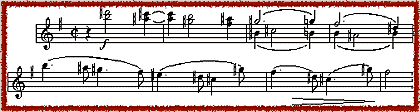
Theme 2a is yet another manifestation of Brahms' fondness of "melodic displacement," the starting of melodies in such a way that they alter one's perception of where the downbeat should fall. In addition to the melody's displacement, the bass line accompaniment also falls on odd beats. Due to this rhythmic ambiguity, and the sometimes clandestine harmonies used by Brahms, establishing a solid, finite key is once again hindered. One could argue that the pedaling F#'s in the bass line are really hinting at the upcoming [ending] key signature of B major (in Theme 2b). At the last moment, the F# chord functioning as I, becomes a V7 chord in B when both the violas and the horns sound e-naturals (making the F# chord a V/IV). Interestingly, the cadence sounds at the last possible point before theme 2b is heard (in B- major). Therefore, the best choice for the tonic should probably be F#. However, due to the fact that there is evidence of the F# chord becoming a V7 chord, it is neccessary to account for both possibilities. The real question is whether you have two themes, or perhaps one theme with an extended V chord for the first period. Considering the differences in melodic content, the evidence to support having two themes is probably greater: the brevity of the F#7 chord, and the obvious discrepancies in the antecedent phrases. Obviously, Brahms is playing with the listeners' ears and demonstrates his desire to keep the music moving via rhythmic and harmonic creativity.

All material within domain http://brianon.ne.mediaone.net is ©1998 Brian O'Neill.